Running a foodservice operation involves a lot of moving parts. And one area that is often overlooked is the question of how to reduce food waste in restaurants.
Food waste costs restaurants a staggering $162 billion per year, and in America alone, restaurants generate as much as 33 billion pounds of food waste per year. This is a serious issue on its own, but becomes even more concerning when you consider that an estimated 50 million Americans face food insecurity.
However, the situation isn’t all doom and gloom. With a better understanding of how to reduce food waste in restaurants, restaurateurs can play a crucial role in solving this challenge. And when you pair these food waste management strategies with a great restaurant recycling program, you’ll be well on your way towards running a more sustainable business.
In this article, we’ll cover everything you need to know to kick restaurant food waste to the curb, including:
- Different types of food waste at restaurants
- 16 restaurant waste management tips
- The benefits of restaurants reducing food waste
Different Types of Restaurant Food Waste
The first step in learning how to lower the amount of food waste in restaurants is simply understanding the two types of food waste you’ll encounter.
- Pre-Consumer Waste: This includes all of the stock wasted in your restaurant before it ever even reaches your guests. For example, if your new line cook gets a little too enthusiastic on the grill and burns a steak that can no longer be served, this is pre-consumer waste. It accounts for 4 to 10% of restaurant food waste.
- Post-Consumer Waste: This includes all food that gets thrown out after it reaches your customers, and is by far the larger category of food waste. Guests typically leave 17% of their food uneaten, and of those leftovers, more than half get left behind on the table at your restaurant. Several factors can cause post-consumer waste, and we’ll dig into how to tackle those next.
Determining how much of your food waste falls into these two buckets can help you identify exactly what is getting thrown out and why. And with a better understanding of your pre- and post-consumer waste, you can determine the right restaurant waste management solutions for your restaurant, which we’ll cover below.
How to Reduce Food Waste in Restaurants: 16 Tips
Here are 16 restaurant food waste management strategies to employ in your venue.
1. Conduct a Food Waste Audit
As mentioned above, knowing how to reduce food waste in restaurants requires you to first find out where your waste is coming from. The best way to do this is to create a food waste tracker (this can be as simple as a hard copy sheet of paper) to account for all of your front- and back-of-house food waste for a given period of time, such as one week. Include the item plus its weight or amount, how it was wasted, the date and time, and the staff member’s name who reported it.
Next, if you’ve been following restaurant inventory best practices, you should be able to compare the information on your food waste tracker with data from your POS system’s inventory reports or restaurant back office software to pinpoint where your food waste is coming from.
2. Promote Sustainable Preparation
Another useful restaurant waste management strategy is to promote sustainable preparation and aim to run a sustainable restaurant more generally. First and foremost, sustainable practices are good for the environment. Another bonus? The number of Americans who make food and beverage choices based on sustainability has increased by 23% since 2019, so implementing environmentally friendly practices at your restaurant is sure to be a crowd-pleasing choice.
Training your employees on proper food preparation techniques is an easy and effective way to ensure perfectly good food doesn’t end up as food waste. For example, wash all of your fruits and vegetables at the same time to conserve water, and use a thaw rack instead of water to thaw frozen food.
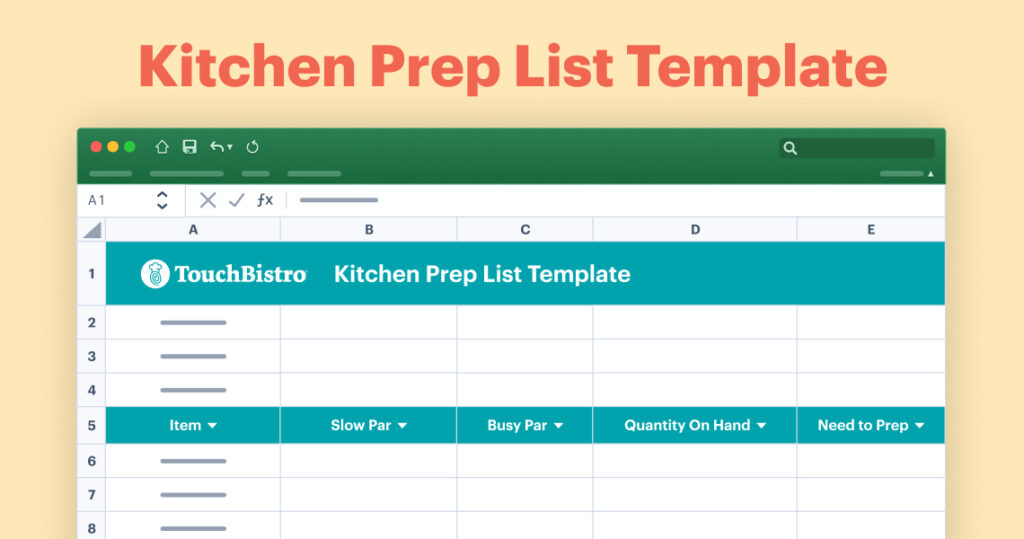
Use this kitchen prep list template to ensure all necessary prep is completed prior to service.
3. Avoid Over-Preparing for Food Waste Reduction
Your specific inventory needs will vary depending on the time of year and even the weekday. For example, if your restaurant is located on the beachfront in a tourist town, you’ll want to have more food on hand during the summer months and especially on weekends, when people are flocking to the water. Alternatively, if you’re based in your city’s business district, weekday lunch hour may be your time to shine.
Use your POS reports to forecast how busy your restaurant will be at different times and prepare accordingly, instead of always over-prepping which can lead to food waste. This way, at the end of the night, you won’t have to throw out any extra salad toppings you chopped during prep.
4. Improve Your Inventory Management
We’ve given you the grim numbers on food waste, but did you know that spilled or wasted booze can equate to anywhere from 2 to 23% in lost sales? This is why mastering restaurant inventory management for all of your food and beverage items is a critical part of learning how to manage your percent of food waste in restaurants.
One restaurant waste management pro tip is to use the first-in, first-out (FIFO) method to rotate your inventory, bringing older items to the front of your storage areas so you ensure they get used before they spoil. Labeling all of your items with use-by dates will make this a breeze. You should also use inventory management software to help you stay organized.

5. Store Food Properly
You can “Marie Kondo” your fridge until it’s meticulously stocked, but no level of organization can save your restaurant’s food from being stored at the wrong temperature. Your refrigerator temperature should be at or below 40° F, and never allow foods that require refrigeration (including leftovers that were once hot) to sit at room temperature for more than two hours to avoid food waste. Frozen foods should be stored at 0° F.
Be diligent about following these temperature guides, and create a backup plan for what to do if things go wrong – for example, how to handle perishables if there’s a power outage.
6. Calculate and Control Inventory Days on Hand
One way to improve your inventory management is by familiarizing yourself with the calculation for inventory days on hand (DOH), and using it to control what and how much of each item you’re bringing in from vendors.
DOH refers to how long an item has been in storage (bag of potatoes on the back shelf, we’re looking at you). To calculate DOH, all you have to do is find the average number of days you hold inventory before selling it. A POS system and robust inventory tracking practice will set you up for success.
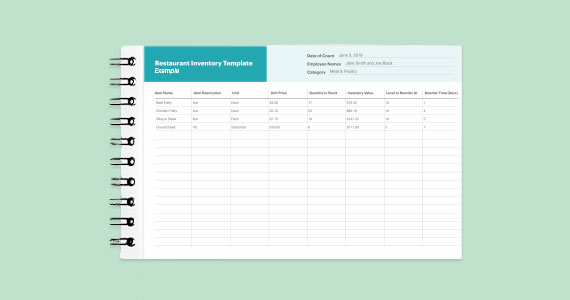
Simplify your inventory counts with our free restaurant inventory template.
7. Repurpose Ingredients
It’s time to get creative! This is the fun part! Work with your kitchen staff to find innovative ways to repurpose food that would otherwise go to waste, like turning day-old bread into croutons.
Remember, many of your restaurant’s customers are likely interested in sustainability, so you can even involve them in this process by taking to social media to find out how they repurpose ingredients in their own kitchens at home. Run a contest and offer the winner a free meal to build brand loyalty. Helping the planet while delighting your guests are two of the major benefits of reducing kitchen food waste.
8. Identify Multi-Use Menu Items
Another important business waste management tip is to figure out which of your ingredients can be cross-used in multiple dishes, such as items you stock regularly and/or in large quantities. This will help you take advantage of the cost savings of buying in bulk, while ensuring that none of your ingredients spoil to become food waste because they don’t get used often enough.
Keep in mind that, having too many menu items can make the process of identifying multi-use items difficult. Find other ways to streamline this activity. For example, switch to a small menu at your restaurant, which will be easier to manage.
9. Order In-Season
Ingredients that are out of season (think peaches in winter if you live in Minnesota) may spoil quickly, so try to avoid using these items in your dishes. Securing in-season ingredients is not only a smart move to achieve food waste reduction in your restaurant, but it also means you’ll likely be sourcing ingredients from closer to home – and who doesn’t love to support local producers?
10. Reduce Portion Sizes for Food Waste Management
We hope you brought your appetite to this party, because in 2017, the average restaurant portion size in the U.S. was anywhere from two to eight times bigger than USDA or FDA standard servings. This is one of the major drivers of post-consumer food waste. As a restaurateur, implementing strategies such as using smaller plates or serving less meat can decrease restaurant portion sizes and in turn, food waste.
Use this kitchen prep list template to ensure all necessary prep is completed prior to service.
11. Track the Popularity of Your Dishes
Having the best restaurant isn’t a popularity contest, except when it is. A menu management system can enable restaurants to reduce waste and identify unpopular dishes. Then, be ruthless and remove these poorly selling items from your menu. No hard feelings, though! Just less pre-consumer food waste.
12. Reducing Food Waste with Weekly Specials
Another way to get creative while cutting down on food waste is to come up with ideas for specials that feature ingredients you have to use before they spoil. Take the opportunity to build team culture and involve your staff in the experience. Give out a prize to the cook who comes up with the most weekly special ideas, or the server who is able to sell the most specials in a night.

13. Offer Takeout Containers
We’ve likely all had the experience of being on our way home from a restaurant when we realize we left our takeout container on the table. Help prevent post-consumer food waste like this by making it easy for guests to take uneaten food home. Encourage guests to take a doggy bag of leftovers, and always keep proper takeout containers on hand – nowadays you can even get sustainable options.
14. Offer Staff Meals
Staff meals are undoubtedly one of the best perks of working at a restaurant. But, have you ever thought that they can also help you minimize food waste? Get creative and use leftover ingredients to make meals for employees. This way, no one’s hangry at work and you have the peace of mind of knowing you’re reducing your waste. It’s a win-win!
15. Donate Leftovers to Charity
Sometimes, even after you’ve followed all of the restaurant waste management tips we’ve covered above, you’ll find that you still have extra food in storage. Remember to ensure food safety and you’ve already whipped up meals for your staff, and see if you can find a local charity to give the items to as a donation.
In addition to making a donation, you can even make it official and set up a partnership with an organization like Second Harvest that can regularly distribute your extra food to those in need. This is easy to do with Sustainable America’s handy Food Rescue Locator, which helps connect businesses with local organizations specializing in food redistribution – all you have to do is enter your ZIP code.
16. Reducing Food Waste by Compost Whenever Possible
Building on the idea of leveraging partnerships to decrease food waste at your restaurant, if you work with local suppliers, ask if you can provide them with compost. Or, you can even compost on-site if you have enough space (and if it’s permitted by your local health authority).
The Benefits of Reducing Wasted Food in Your Restaurant
Your notebook should now be brimming with ideas for how to reduce food that goes to waste – and how to put them into practice ASAP. Also, cutting down on food waste can help boost your bottom line by decreasing operating costs by up to 30%.
But, this isn’t all about reducing operating costs. As you’ve learned, decreasing food waste is also good for the environment. This is a strong selling point for eco-conscious customers, especially those in the millennial age group. According to The National Restaurant Association, 58% of millennials gravitate toward restaurants that source sustainable food.
And lastly, one of the biggest benefits of lowering your amount of food waste is that you can help people in your community who are struggling with food insecurity. Need we say more?
FAQs
How can restaurants cut plate and kitchen waste effectively?
Restaurants can effectively cut plate waste (front of house waste) and kitchen waste (back of house waste) by following these tips:
- Cutting Plate Waste: Plate waste happens when guests leave food behind on their plate. The best way to reduce this is to track what returns uneaten and adjust portion sizes accordingly, offer flexible portions (i.e. half portions), de-link default sides, and to make take-home packaging standard.
- Cutting Kitchen Waste: Kitchen waste usually stems from over-purchasing, poor prep tracking, or inefficient storage. The best way to reduce this is to implement a waste audit, enforce the the First-In, First-Out inventory rule stringently, cross-utilize ingredients in multiple dishes, and shift from mass prep morning blocks to progressive prep throughout the day.
How to use POS data to lower restaurant food waste?
The best way to use your POS to reduce restaurant food waste is to combine POS data with advanced inventory tracking software. For example, with TouchBistro POS and Inventory Management, you can use your POS sales data and your inventory data to determine your Food Cost Variance, which is the gap between what your theoretical costs and what you actually sold. Once you identify the discrepancy, you can make adjustments to reduce any waste.
How can small restaurants minimize daily food waste?
The best way for small restaurants to minimize daily food waste is with lean systems that don’t require expensive technology or massive teams to maintain. One of these systems is switching to “progressive prep” (batch cooking), which involves prepping throughout the shift as needed, rather than first thing in the morning. Another system is implementing a clear-the-walk-in” daily special, which involves the head cook or chef creating a daily feature that uses up items nearing their expiration date. Lastly, small restaurants can use hard portioning tools to standardize portion sizes.
What’s the best way to conduct a restaurant food waste audit?
The best way to conduct a restaurant food audit is to implement a lightweight, 7-day audit that follows these steps in sequential order:
- Set up 3 distinct waste sorting stations: one for prep waste, one for unserved/spoiled waste, and one for plate waste.
- Brief staff: host a 5-minute meeting that reiterates the importance of the waste audit, without framing it as punitive.
- Weight and log at every shift change: Have shift leads weight each waste bucket at the end of the lunch and dinner shifts and record the weight.
- Calculate waste costs: Convert total weight into financial loss using average raw ingredient costs: Estimated Financial Loss = Total Waste Weight (lbs) x Average Cost per lb Then, compare this against total covers served during the 7 days to find your Waste per Cover Metric (lbs of waste/total guests).
How to measure food waste in restaurants accurately?
The most accurate way to measure food waste in restaurants is to understand the cost, cause, and volume of waste. One low cost way of doing this is with a bin on a digital floor scale. The problem with this manual method is that it is highly dependent on team consistency and honesty during busy rushes. A more precise way of measuring waste is with an automated smart scale system with a built-in camera. In this case, the camera uses computer vision to identify the item dumped in the bin, records its exact weight automatically, and tags the cost per pound based on your inventory invoices.
What are effective restaurant food waste management tools?
Effective restaurant food waste management tools include hardware (smart scales), mobile software, POS integrations, and surplus redistribution apps. The best choice depends on kitchen size, volume, and budget. Smart scales and automated hardware like Winnow Vision, Leanpath, and Orbisk are best for high-volume restaurants, while software and apps like Xenia, Supy, and SafetyCulture are best for independent kitchens.
How to reduce food waste in restaurants without hurting sales?
The best way to reduce food waste without hurting restaurant sales is by reducing volume behind the scenes, not value in the eyes of the guest. The best ways to do this include reducing high-waste sides (i.e. the fries that come with a burger), reorganizing your menu to optimize for cross-utilization of ingredients, shifting from static prep to progressive prep, making use of surplus for off-peak channels (i.e. offering limited-time delivery dishes later in the evening using prepped line items that cannot be held overnight), and by enforcing portion accuracy among staff.
Get the Tech You Need to Track Food Waste
We’ve covered different types of food waste, 16 restaurant waste management tips, and the benefits of lowering food waste in your business. If you’re ready to set restaurant goals to reduce food waste, make sure you have a POS system and inventory management system that can support you. Find out how TouchBistro’s restaurant POS system can help.

Katherine is the Content Marketing Manager at TouchBistro, where she writes about trending topics in food and restaurants. The opposite of a picky eater, she’ll try (almost) anything at least once. Whether it’s chowing down on camel burgers in Morocco or snacking on octopus dumplings in Japan, she’s always up for new food experiences.
Learn how to make the most of your restaurant reports
Get our restaurateur newsletter: The Bistro Insider

Your Complete Guide to Restaurant Reservations
Download Guide